I wrote my last post on my way to Strasbourg for the formal opening session of the new Parliament. That week, the first week of July, was a whirlwind of voting and media sessions (all the TV journalists come to film their new MEPs arriving in Strasbourg and then talking about their first impressions). Wednesday was particularly busy, with voting happening all day and media interviews and debates slotted in wherever the journalists could get access to one of the spaces for such activities. I did a debate for the BBC (for Sunday Politics) at 8.30 a.m. and for ITV (for Late Edition) at noon. (The 8.30 a.m. fixture meant taking breakfast in my hotel at 0630 and then figuring out how to work the ticket machine at the tram stop at 07h20— this is not as easy as you might think, since we are so used to touch screens that it doesn't seem obvious that you might need to turn a knob until it has moved the cursor to the right option that you want to select, and then press the button in the knob not jab at the screen!).
The other practical difficulty I had with this was that I had arrived in Strasbourg after two weeks of travelling, both conference and holiday travels, with as little luggage as possible and very few outfits of a smart variety; so some of my smart clothes needed to be washed and some needed to be ironed. The hotel turned out to be ill-equipped for this purpose: there was one iron and ironing board that guests could borrow, but it had been borrowed by someone before I got back from parliament on Monday and was not returned before I had to leave on Tuesday (for the breakfast meeting with other UK Green Party MEPS). On the other hand, laundry had to be sent out to an outside provider. I managed to get hold of the iron at about 23h00 on Tuesday and that meant I had one reasonably presentable dress that I could wear on Wednesday for the TV debates, but not a lot of sleep!

Work began on Monday with a meeting of the Green Group. Before that I was given the keys of my new office in the Strasbourg building, which is absolutely beautiful (the office I mean, though the building is also beautiful). It's a single office with two desks, and has a view over Strasbourg. All the Green MEPs have rooms along the same corridor and mine has a door to the adjoining office which belongs to Scott Ainslie from London.
The first session of parliament began with an opening ceremony on Tuesday. This was the occasion on which a strange little trio of musicians performed a version of the Ode to Joy which is the anthem of the EU. The UK Brexit Party MEPs made the UK look silly by turning their backs during this ceremony, and some other far right groups including the Tory party sat down for it, while the rest of us stood to honour the idea that the EU represents, of cooperation and peace by collaboration to make things better for all of us.

Here I am in my place in the Hemicycle where the full parliament meets,
and with Lucy Nethsingha from the Liberal Democrats who sits a bit along from me on the same row:
And then there were the votes. We did a lot of voting, and for reasons that are not entirely clear we had to do the voting on printed pieces of paper, and then there was a long time for the counting and then time for the printing of the next set of voting papers.
We were voting initially for the President of the Parliament. Thanks to some weird manoeuvres in the back rooms of power in the EU, where they try to stitch up a coalition to secure a majority in parliament, the candidates presented for all the key posts were not the ones we had expected. Coalition and alliance negotiations seem to be all about which countries and which parties get which jobs, and not at all about what policies we are demanding in return for our votes. We in the Green group were much more interested in securing some concessions and commitments on progressive policies, rather than squabbling over who can have the top positions in the council, commission, European bank and so on. But obviously the other parties were not so much wanting to make any commitments of that kind.
Anyway, their new proposals for who gets what job don't look any more likely to pass the required parliamentary majority than the previous ones. But the chaos and intrigue that they've cooked up meant that the whole week was devoted to frantic explorations on the part of all the party groups, to work out what strategy we should pursue in response to the unexpected attempt to foist unexamined candidates into the positions. Presumably the Brexit party, having no group to belong to and no interest in the EU democracy, had no strategy worked out at all, since they didn't bother to stay for the voting. Well they stayed (and—I think— must have abstained) for the first round, presumably because you can't qualify for any pay if you don't take part in the voting.
We in the UK have been very much out of the loop in all the preparations for these key votes, because no one really expected us to be there, so it was quite hard to catch up and follow what the issues were, but we had some interesting results in the votes, and several speeches asserting the importance of real democracy in electing these positions. So far only one of the key figures has been elected (the president of the parliament for 2 and half years), but the next controversial appointment comes up for election this coming week in Strasbourg and it's not all that clear how the voting will go, so watch this space.

Voting went on until 9 pm on Wednesday. It was during the heatwave, so it was lovely to come out of the parliament into a warm night and go and find some dinner in town.

The city is lovely. I discovered a restaurant near my hotel that continues to serve hot food till midnight. This looks as if it may be something that is very relevant!
One can also enjoy the beauties of the city in the late evening.
This is my place in the Greens/EFA meeting room where we spent hours figuring out our strategy for how to vote in the elections for President, Vice Presidents and what to do about the candidate who's been put up for President of the Commission.
The Green Group meeting rooms are a bit small, especially in Brussels, now that our group has grown from being a small player in the parliament to being a big player. There are seats for all the MEPs, but we tend to have a lot of assistant staff sitting on the floor during the meetings in Brussels.

On Thursday we were free to leave from around 1130, and I caught a train from Strasbourg at 1217. Unfortunately it ended up running over half an hour late, and as a result I was too late for the 30 minute check in rule at the Eurostar. I didn't have a fully flexible ticket since it was one that I had booked as part of my original plans for travel for the conference, before I got elected. It turns out that it's going to be regularly worth booking the more expensive tickets, just so that you don't have to experience the rather unpleasant and unkind staff at Eurostar. There was another woman at the gate in tears. It's a hostile world if you are unlucky with the trains and have spent all you could afford on the tickets you've just been refused entry with. That's another reason why charging for privileges on public transport is an iniquity: as though the ones who can afford to pay deserve better treatment, when in fact it is typically the unfortunate people who need more help, often having to travel urgently at great expense for a funeral or to visit someone who is dying. We need to rethink the way society is organised and how its opportunities and penalties are distributed.
On Friday I spent all day interviewing for the office staff for my UK office. This took from 9 in the morning to nearly 6 pm (we got thrown out of the building in the end). I was fortunate to have help from wonderful advisers from the regional green party, and from Adrian Ramsay who has been assisting me with the administrative tasks in the UK. I was really pleased with the range of candidates who applied, with the quality of the ones we were able to short list, and with the final appointments we were able to make. From late July and early August I shall have a full time constituency coordinator to run the office and a pair of job-share press and publicity officers to help me with communicating my messages to the wider audiences in the region via print and broadcast media and via social media. On Monday, before I left for Brussels I was able to visit some possible office buildings, assisted by Adrian Ramsay, and I have now taken a lease on a suitable office in Sackville Place, which is both affordable and serviced, and available for the
short period without any longer term commitment that we are unfortunately needing right now.

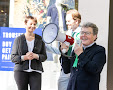
In between Friday and Monday there was Saturday, when I went to Cambridge to join the Eastern Region Green Party summer conference (with a good turnout from members across the region), and to speak at the "Streets for Life" and XRebellion event where they had closed off part of the city centre to traffic and made a garden in Downing Street.
It was lovely to see Cambridge as it should be, with people walking in enough space to walk in. I gave a speech at both events, and also had a couple of interviews with the media.
Then on Monday it was back to Brussels, after the visits to look at offices. This week in Brussels was taken up with establishing the committees and voting in the chairs and vice chairs of the committees. There were also working groups in which we prepared for these tasks and for the coming work in relation to the legislation we are seeking to progress over the next few weeks. Quite a lot of the committees had very controversial elections to the chairs and vice chairs, with some failing to complete the process where the candidates proposed by some parties were unacceptable or where the gender balance (lack of) was contrary to the rules. So there is some unfinished business there.
In one of the committees (the one relating to Petitions) the Greens/EFA group was entitled to nominate someone for the first vice chair position, and I was recruited as a substitute to go and nominate her because our other members of the committee were all tied up. So I did my bit, nominated Tatjana Żdanoka for vice chair, and she was duly elected!
Here is a picture of the event:
Besides these tasks, because I serve on the foreign affairs and human rights committees, I was swiftly involved in some initiatives to bring "urgencies" about human rights abuses to the next Plenary session in Strasbourg. In particular, because I am specialising in Russia, I was keen to get a role in the one that is on Russia, about the situation of environmental activists and Ukrainian political prisoners. Hopefully I may get to speak to that or at least take part in the negotiations on the finished wording.
Besides the Foreign Affairs and Human Rights work, I am also involved in the Transport committee which has some really interesting work coming up. In that committee I have offered to specialise on work to clean up shipping and maritime pollution.
Finally, on Thursday morning last week I and some of the other Greens and EFA members attended a very important training session on Sexual and Psychological Harrassment. We as a group put a high priority on mandatory training for MEPs in this matter, to ensure that the working environment in our offices is healthy and not exploitative or intimidating.
 Other tasks in my diary for August included speaking at a new members's day for Norwich Green Party, a day of media training with my fellow Green MEPs in London, followed by an away-day for team building for the group of us together in Herefordshire, some strategic meetings in the East of England relating to General Election strategy, and, of course, much effort and engagement with the crises in the UK political scene during what was an unusually silly silly season.
 On 15th August I attended a fascinating event held in North Walsham, the North Norfolk Environment Forum, where the council and experts and representatives of various groups were brainstorming together in a fruitful way concerning how to address the very real threats to the region from climate change, and the radical changes to practices and responses that are needed in the region to meet the challenges.


 Work began on Monday with a meeting of the Green Group. Before that I was given the keys of my new office in the Strasbourg building, which is absolutely beautiful (the office I mean, though the building is also beautiful). It's a single office with two desks, and has a view over Strasbourg. All the Green MEPs have rooms along the same corridor and mine has a door to the adjoining office which belongs to Scott Ainslie from London.
 Here I am in my place in the Hemicycle where the full parliament meets,

 The city is lovely. I discovered a restaurant near my hotel that continues to serve hot food till midnight. This looks as if it may be something that is very relevant!


 In between Friday and Monday there was Saturday, when I went to Cambridge to join the Eastern Region Green Party summer conference (with a good turnout from members across the region), and to speak at the "Streets for Life" and XRebellion event where they had closed off part of the city centre to traffic and made a garden in Downing Street.


 After tiring my legs out with walking round Genoa, I collected my luggage from the station and took a taxi down to the port from which my ferry was leaving for Sardinia.

 With some of them I struggled to follow the very rapid delivery in Italian, but some made an effort to help those of us who were not native Italian speakers. We dined and breakfasted well in a wonderful place with views over the harbour from the bastion.


 And after doing two jobs all week, I then spent part of Saturday