As Christmas approaches, the shops are full of gadgets that you imagine, just for a moment, might be useful until you think about why they can't possibly do anything you couldn't do better yourself. And meanwhile the Universities are being pressed to discover things that have some commercial potential, so that they can prove that having great brains at work is worth the money.
What about the marvellously simple invention that costs nothing at all, and saves you having to buy some gadget or equipment or tool that costs a lot? Something for free that does the job just as well or better? Is that worth inventing? I find myself doing so all the time.
Here's one from this week. "No-bracket bike lights".
The problem: you have more than one bicycle. One of your bikes has battery lights that clip onto brackets fixed to the cycle. Now you need to ride the other bike which has no brackets for the lights (because the lights came with just one set of brackets), and no lighting set of its own.
The solution: (1) clip the back light to your reflective belt, back pocket of your rucksack or back pocket; (2) find one of the red rubber bands that the postman drops. Fold it double and wrap it round the handlebars or steering column of the bike in such a way that there are two loops, one on either side of the bar. Rest the front light on the handlebar or against the column, and pop the two loops over the front and back end of the sausage-shaped bike light. Adjust the tension of the loops by moving parts of the band from front to back or the reverse, until your lamp is pointing roughly in the right direction. Hey presto: hands-free lighting.
Showing posts with label Bicycles. Show all posts
Showing posts with label Bicycles. Show all posts
Friday, 13 November 2009


Monday, 4 May 2009
A list of my bicycles again
It's a while since the series of posts in which I described my collection of bicycles, and things have moved on since then, so I think I should do an update.
I now have three bicycles in Cambridge and two in Norwich. In addition there is "Chris's bike" which is a man's bike, so I don't count that as mine.
Among these five (or six) remaining bikes is, of course, horrid pink bike. I thought for a bit that I had found someone who would like to use it, but it's come back to haunt me again. It's in Norwich, and it's not locked, and I'm waiting to see if it will ever find someone who loves it enough to take it.
Also in Norwich is a new blue bicycle, with a fine new basket and carrier and bell. This is a replacement for the green bike ("New Norwich Bike") which, in my earlier posts on this topic, I was just trying to take to Norwich. That New Norwich Bike is now no more, or rather it was taken by someone when I'd parked it at Earlham Road Shops, so I have it no more.
I've also lost the horrid black mountain bike, which is sad because it had a nice dynamo and two very fine new tyres. I took it to the bike man at UEA and asked him if he would buy it from me. He said I'd get more money if I advertised it, which was doubtless true—or would have been if I'd got that far— but I could hardly be bothered. But I did take it away and lock it up outside the Arts Building. Never saw it again: couldn't find it a week later.
So I've lost two bikes in Norwich and I'm trying hard to lose a third.
In Cambridge, I reclaimed the ten speed purple pioneer from Christian, thinking I would take it to Oxford and then to Norwich (to replace the one I'd lost at Earlham Rd Shops). But it was too uncomfortable to ride, so I traded it in for the new blue one.
In Cambridge I also have a very nice old fashioned green bike, three speed, with full chain case and rod brakes. Excellent: I bought it second hand from Kingsway Cycles a while back. Also my mother's bike (described previously) and spiffy bike (ditto). I don't really need three, but the one to lose would be my mother's and I don't think I can just discard that for sentimental reasons. Perhaps I should look for someone to borrow it, though at present it's the one to ride to the station on days when I have to go to Norwich with a brief case. Perhaps I do need it after all...
I now have three bicycles in Cambridge and two in Norwich. In addition there is "Chris's bike" which is a man's bike, so I don't count that as mine.
Among these five (or six) remaining bikes is, of course, horrid pink bike. I thought for a bit that I had found someone who would like to use it, but it's come back to haunt me again. It's in Norwich, and it's not locked, and I'm waiting to see if it will ever find someone who loves it enough to take it.
Also in Norwich is a new blue bicycle, with a fine new basket and carrier and bell. This is a replacement for the green bike ("New Norwich Bike") which, in my earlier posts on this topic, I was just trying to take to Norwich. That New Norwich Bike is now no more, or rather it was taken by someone when I'd parked it at Earlham Road Shops, so I have it no more.
I've also lost the horrid black mountain bike, which is sad because it had a nice dynamo and two very fine new tyres. I took it to the bike man at UEA and asked him if he would buy it from me. He said I'd get more money if I advertised it, which was doubtless true—or would have been if I'd got that far— but I could hardly be bothered. But I did take it away and lock it up outside the Arts Building. Never saw it again: couldn't find it a week later.
So I've lost two bikes in Norwich and I'm trying hard to lose a third.
In Cambridge, I reclaimed the ten speed purple pioneer from Christian, thinking I would take it to Oxford and then to Norwich (to replace the one I'd lost at Earlham Rd Shops). But it was too uncomfortable to ride, so I traded it in for the new blue one.
In Cambridge I also have a very nice old fashioned green bike, three speed, with full chain case and rod brakes. Excellent: I bought it second hand from Kingsway Cycles a while back. Also my mother's bike (described previously) and spiffy bike (ditto). I don't really need three, but the one to lose would be my mother's and I don't think I can just discard that for sentimental reasons. Perhaps I should look for someone to borrow it, though at present it's the one to ride to the station on days when I have to go to Norwich with a brief case. Perhaps I do need it after all...
Thursday, 26 March 2009
Things calculated to annoy a cyclist
Every road on the main cycle routes across Cambridge has been dug up this winter. In particular, the routes to get from East of the city, or North East, into the city, or to the Sidgwick site, or to the station, or to Trumpington Street/Silver Street, or to the University Library, or to anywhere any civilised person wants to go... all of them have been dug up, all at the same time.
When they dig up the road they make a large hole. Then they park their digger next to the hole. Then they park their portable toilet next to the digger, or on the other side, next to the hole. Then they fence the entire thing round, enclosing any remaining space between their hole and the pavement. Then they put up a big notice saying that the road is closed (or, in this case, a sign saying go to the left of this blockage, as though there were still a way past). The fact that it was the only cycle route for you to get to work or to the station is, of course, not their concern. While I was taking this photograph (which is a picture of the ten minute route from here to the station, in this case through Kingston Street) sixteen cyclists came by, and every one of them had to dismount (luggage, children and all) hump up onto the pavement, walk past, hump down again, climb on again, etc.
Why did they still do that? Because the next nearest way round, involving dropping down to Gwydir Street and going round by St Barnabas road instead of Devonshire road, is about twice as long and involves three sets of traffic lights, making this a twenty minute journey instead of a ten minute one.
I didn't think to get any pictures of the similar works on King Street, which were helpfully timed to be at the same time as yet another set of (still ongoing) works on Jesus Lane, so that both of the two main arteries into Cambridge for cyclists from the East were closed at the same time. It's true that Jesus Lane is not wholly closed... but it has traffic lights, which are extremely slow and add a great deal to the journey time. What is more, whereas at an earlier stage it was possible to by pass the problem on Jesus Lane by going round by King Street, now they have gratuitously moved the Jesus Lane traffic light back like this:
 This is the view of it where you come out from Malcolm Street onto Jesus Lane opposite Wesley House. This used not to have a traffic light, so you could turn left at will providing no traffic were coming from the right, and you could turn right into Malcolm Street from Jesus Lane even if the traffic light, which was a bit to the right of this junction, were red. Not so now. As you can see the traffic light here is quite isolated from the road works: the works are way down the road to the right. Why stop the traffic here? Just to make life difficult for the cyclists, to prevent them from avoiding the problem by way of King Street and Malcolm Street...
Which way would you go if you couldn't do Jesus Lane and Trinity Street, or King Street and ... (well where do you go from there? It's a designated cycle route, but then you're not allowed to go through Sussex Street, for some incomprehensible reason, and the police, just to aggravate everyone further, have been having a campaign to stop the poor cyclists from going through Sussex Street, which was their last resort... but just how are you supposed to get to Green Street, which is also a designated cycle route? and just how are you supposed to get from Midsummer common to King's)
Anyway, suppose you decide instead to go by way of Emmanuel Road and Downing Street. Now, this is what greets you:
 In this case they have closed not only the left side of the road (we're looking East here) but also the contra-flow bike lane on the right. They know we won't like it, and that it is a crucial cycle route, so they specially put up a notice telling us we must dismount. I realise I haven't got a picture of the offensive blockade that they've put up at the Trumpington street entrance to this route.
What exactly is the city's policy with regard to encouraging cycling? I ask in genuine bemusement.
By the way, I've never seen anyone digging in these places. You'd have thought that they could at least arrange their digger and their toilet booth in a long line while they're off duty, so that the whole blockage was made long and narrow, with room for cyclists to pass on one side. Wouldn't you?

When they dig up the road they make a large hole. Then they park their digger next to the hole. Then they park their portable toilet next to the digger, or on the other side, next to the hole. Then they fence the entire thing round, enclosing any remaining space between their hole and the pavement. Then they put up a big notice saying that the road is closed (or, in this case, a sign saying go to the left of this blockage, as though there were still a way past). The fact that it was the only cycle route for you to get to work or to the station is, of course, not their concern. While I was taking this photograph (which is a picture of the ten minute route from here to the station, in this case through Kingston Street) sixteen cyclists came by,
 and every one of them had to dismount (luggage, children and all) hump up onto the pavement, walk past, hump down again, climb on again, etc.
Why did they still do that? Because the next nearest way round, involving dropping down to Gwydir Street and going round by St Barnabas road instead of Devonshire road, is about twice as long and involves three sets of traffic lights, making this a twenty minute journey instead of a ten minute one.
I didn't think to get any pictures of the similar works on King Street, which were helpfully timed to be at the same time as yet another set of (still ongoing) works on Jesus Lane, so that both of the two main arteries into Cambridge for cyclists from the East were closed at the same time. It's true that Jesus Lane is not wholly closed... but it has traffic lights, which are extremely slow and add a great deal to the journey time. What is more, whereas at an earlier stage it was possible to by pass the problem on Jesus Lane by going round by King Street, now they have gratuitously moved the Jesus Lane traffic light back like this:

 This is the view of it where you come out from Malcolm Street onto Jesus Lane opposite Wesley House. This used not to have a traffic light, so you could turn left at will providing no traffic were coming from the right, and you could turn right into Malcolm Street from Jesus Lane even if the traffic light, which was a bit to the right of this junction, were red. Not so now. As you can see the traffic light here is quite isolated from the road works: the works are way down the road to the right. Why stop the traffic here? Just to make life difficult for the cyclists, to prevent them from avoiding the problem by way of King Street and Malcolm Street...
Which way would you go if you couldn't do Jesus Lane and Trinity Street, or King Street and ... (well where do you go from there? It's a designated cycle route, but then you're not allowed to go through Sussex Street, for some incomprehensible reason, and the police, just to aggravate everyone further, have been having a campaign to stop the poor cyclists from going through Sussex Street, which was their last resort... but just how are you supposed to get to Green Street, which is also a designated cycle route? and just how are you supposed to get from Midsummer common to King's)
Anyway, suppose you decide instead to go by way of Emmanuel Road and Downing Street. Now, this is what greets you:
 In this case they have closed not only the left side of the road (we're looking East here) but also the contra-flow bike lane on the right. They know we won't like it, and that it is a crucial cycle route, so they specially put up a notice telling us we must dismount. I realise I haven't got a picture of the offensive blockade that they've put up at the Trumpington street entrance to this route.
What exactly is the city's policy with regard to encouraging cycling? I ask in genuine bemusement.
By the way, I've never seen anyone digging in these places. You'd have thought that they could at least arrange their digger and their toilet booth in a long line while they're off duty, so that the whole blockage was made long and narrow, with room for cyclists to pass on one side. Wouldn't you?
Saturday, 12 January 2008
Life in the fast lane
This entertaining video gives a glimpse of how we get about in Cambridge. You will see that bicycles are much faster than cars and other motorised transport....
Thursday, 5 July 2007
Hooray for wellington boots!
This week I bought a wonderful pair of wellies. They're pistachio green with pink trimmings and pink and blue spots. Just right for the summer.
I've decided to wear them all the time.
One huge advantage is that it makes it practical to ride my bike while wearing pale or white trousers, even on a bike with no chain guard, and even in wet conditions.
This is a major improvement to the quality of life. When I get a chance I will add a photo.
I've decided to wear them all the time.
One huge advantage is that it makes it practical to ride my bike while wearing pale or white trousers, even on a bike with no chain guard, and even in wet conditions.
This is a major improvement to the quality of life. When I get a chance I will add a photo.
Tuesday, 29 May 2007
Cycling and energy
There's a long running dispute in our household as to whether it uses more energy to cycle fast than to cycle more slowly.
I don't mean does it take more energy for the same amount of time. Obviously cycling faster is harder work, and uses more energy in a short time.
The question is this: if you need to go from here to the Sidgwick site, and you could go gently at, say, 10 miles an hour, or very energetically at about 15 miles an hour, you'd get there quicker by the latter method, but would you have burnt up all your weetabix more effectively?
Well here's the answer. Suppose the Sidgwick site is 2 miles away. Going at 10 miles an hour it will take you 12 minutes. Going at 15 miles an hour it will take you 8 minutes.
If you weigh 10 stone (which I don't, but never mind: we're trying to compare the results for the same person, not different people), riding at 10 miles an hour uses about 381 calories an hour, so you'll use 76.2 calories in 12 minutes.
The same 10 stone individual riding at 15 miles an hour uses about 636 calories an hour. So you'll use 84.8 calories in 8 minutes.
A serving of two weetabix with milk provides 190 calories, so by riding to the Sidgwick site you'll have used less than half your calories either way. But the difference between riding fast and riding slowly is 8.6 calories, which is about 1/10th of a weetabix. So if you are going to ride energetically, you'll need to eat a bit more breakfast if you're not to get hungry before elevenses (but on the other hand you gain an extra 4 minutes in which to go to the Buttery and get a coffee and a doughnut to keep you going).
I don't mean does it take more energy for the same amount of time. Obviously cycling faster is harder work, and uses more energy in a short time.
The question is this: if you need to go from here to the Sidgwick site, and you could go gently at, say, 10 miles an hour, or very energetically at about 15 miles an hour, you'd get there quicker by the latter method, but would you have burnt up all your weetabix more effectively?
Well here's the answer. Suppose the Sidgwick site is 2 miles away. Going at 10 miles an hour it will take you 12 minutes. Going at 15 miles an hour it will take you 8 minutes.
If you weigh 10 stone (which I don't, but never mind: we're trying to compare the results for the same person, not different people), riding at 10 miles an hour uses about 381 calories an hour, so you'll use 76.2 calories in 12 minutes.
The same 10 stone individual riding at 15 miles an hour uses about 636 calories an hour. So you'll use 84.8 calories in 8 minutes.
A serving of two weetabix with milk provides 190 calories, so by riding to the Sidgwick site you'll have used less than half your calories either way. But the difference between riding fast and riding slowly is 8.6 calories, which is about 1/10th of a weetabix. So if you are going to ride energetically, you'll need to eat a bit more breakfast if you're not to get hungry before elevenses (but on the other hand you gain an extra 4 minutes in which to go to the Buttery and get a coffee and a doughnut to keep you going).
Monday, 14 May 2007
What does it mean to be green?

It means taking the children to the station by bike.
Here's a picture I took at Cambridge station one evening in the early spring. I don't know who the family was, but hurrah for such families!
Saturday, 5 May 2007
Things calculated to annoy a cyclist
ld 
As tiger mentioned in a comment on my last post on this theme, one very irritating thing is when you arrive back at your bicycle and find that someone has used the bike basket as a litter bin.
Here is one particularly unpleasant example, found in my bike basket on my return to Norwich last Tuesday. Usually Norwich station is a rather civilised place.
Now what do you suppose the person thought I would do when I found their chips in my basket? Did they think I would go and find a litter bin to put them in? Because if they couldn't themselves find a litter bin, how was I going to do so? And having all the luggage that I needed to put in my basket, I was not in a position to go anywhere to deposit the rubbish. So what can I do except tip it out onto the ground. Do they somehow feel that they avoid the responsibility for leaving litter by transferring it to my conscience instead?
This is, as I say, relatively rare in Norwich (it was a weekly experience at Liverpool Lime Street), but they seem to have installed a flashy new bus shelter on the station forecourt in Norwich, with no litter bins in sight. This seems to me to be ill-advised if you want a tidy and smart environment.

As tiger mentioned in a comment on my last post on this theme, one very irritating thing is when you arrive back at your bicycle and find that someone has used the bike basket as a litter bin.
Here is one particularly unpleasant example, found in my bike basket on my return to Norwich last Tuesday. Usually Norwich station is a rather civilised place.
Now what do you suppose the person thought I would do when I found their chips in my basket? Did they think I would go and find a litter bin to put them in? Because if they couldn't themselves find a litter bin, how was I going to do so? And having all the luggage that I needed to put in my basket, I was not in a position to go anywhere to deposit the rubbish. So what can I do except tip it out onto the ground. Do they somehow feel that they avoid the responsibility for leaving litter by transferring it to my conscience instead?
This is, as I say, relatively rare in Norwich (it was a weekly experience at Liverpool Lime Street), but they seem to have installed a flashy new bus shelter on the station forecourt in Norwich, with no litter bins in sight. This seems to me to be ill-advised if you want a tidy and smart environment.
Friday, 27 April 2007
Things calculated to annoy a cyclist

Cycle racks positioned in such a way that you can't access the further ones when the nearer ones are filled up.
This has the effect that you can't use the further ones, even if you get there first, because you won't be able to get in in order to get out later.
Example, new racks by the front lawn at UEA.
Tuesday, 24 April 2007
Things useful for bringing up children without a car
 Last time we got as far as carrying a small baby in a sling or in a trailer. Next we need a baby seat for the bicycle.
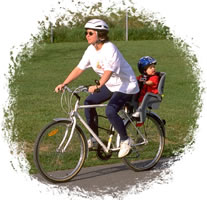
The first is a rear fitting seat, suitable for a child from about 6 months. It has a harness and a high back to support the child, so once the baby can sit up by itself it will be fairly comfortable in here.
My children used to fall asleep in the seat on the back of the bike sometimes. That's a bit awkward, because they tend to loll out sideways. I used to cycle with one hand behind me trying to hold baby in place. Not ideal, but no one ever came to any harm....
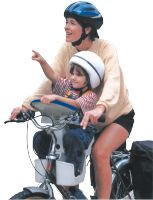 Then you can also add a front fitting seat. These have become more elaborate than they used to be and sometimes include a windscreen. When I had one twenty years ago it was a tiny black saddle with two metal supports, which slotted into a bracket fitted on the cross bar, or the upper of the two angled bars on a women's frame. Then there was a little bracket the provided a foot rest for the child, fitted on the lower bar.
I don't at all like the look of the plastic monstrosity in this picture.
 Here is something more like the one I knew (though now they seem to come with a strap to strap the child to the seat: now that was never necessary in days gone by and surely still isn't).
I see there is a weight limit given for these seats. Well I went on carrying our children on them for many years. I had one on the back and one on the front. I went on carrying both children like this until one fateful day when I stopped at a junction to turn right out of Charles Street onto the Iffley Road, and the whole bicycle started to tip over because it was so top heavy. As soon as the structure had started to tilt it was too heavy for me to hold it up, so all I could do was lower it gently to the ground and take the children off. So then we had to walk home and that was the end of cycling with two children one on the front and one on the back.
I don't remember exactly how old they were. Perhaps 5 and 3. Quite a lot beyond the weight limit they recommend now, for sure.
One might also want helmets for the children. Ours were pink expanded polystyrene, and looked like a blob of ice cream. Now that doesn't sound very green does it?
Saturday, 3 March 2007
Cycling with babies and toddlers in tow

Further to my last post, about what you do with baby when you've left your bike and trailer (or bike with child seat) at a cycle park. Good news for parents in Cambridge is the Park Street Cycle Park pushchair scheme, where you can leave your bike for free and borrow a pushchair instead, to go round town.
I have a sort of feeling my children would have refused to get into a strange pushchair. But perhaps if one had been doing it from their babyhood, it would be perfectly routine and no reluctance would be encountered.
More details here and here.
Wednesday, 28 February 2007
Things useful for the task of bringing up children without a car

Besides a pram, we used to find a baby sling useful.
Before the baby can sit up there's no way of carrying it on a bicycle, but you can strap it to your body and ride a bicycle with the baby held firmly to your front. The sling needs to be one that holds the baby's wobbly head in position, and won't drop baby out as you whizz round corners.
 I think nowadays people sometimes use one of those trailers that goes behind a bicycle and maybe you can put the baby to lie down in it, or put a car-seat type baby carrier in it.
I think it's debatable whether that's safer than a baby sling. I'm not sure I'd terribly want to cycle on the road with baby in a trailer down there behind, where the cars can't see.
The flag at the back rather suggests that the parent is not entirely confident that the cars won't just drive over it.
Monday, 26 February 2007
Things calculated to make a cyclist angry
Speed Humps
Example: the new work on the Avenues in Norwich.
Where there used to be a bicycle lane there is now no bicycle lane, but rather a series of terrible humps and a 20 mph speed limit, which is a volatile combination that causes the motor traffic to be a serious nuisance to bicycles, and bikes to be a serious hazard to motors.
Here, for instance, in the space of three minutes are some of the consequences.

1 The humps are placed such that a car must squeeze in close to the left to get a wheel either side of the hump. As a bike approaches a hump, the car behind must hang back to wait until after the bike has gone past.
2 If the motor vehicle chooses not to hang back and wait, it may pass the cycle at the hump by travelling on the wrong side of the road. However, since it is limited to 20 mph it will need to spend some considerable time on the other side.
3. If there is traffic coming in the opposite direction, overtaking on the right is not an option. The motor vehicle must stay behind.
4 However, 20 mph is not sufficient speed to pass a sequnce of cyclists between humps. If the cycles are travelling at 10 or 12 mph and the motor vehicle is travelling at 20 mph it will not have time to pass even one cyclist, let alone several, before coinciding with a cyclist at the next hump.

In order to get past, then, the motor vehicle is obliged to move out to the right hand side of the road and accelerate as fast as possible, rush past the cyclists on the wrong side of the road, and then swerve urgently into the extreme left, cutting in in front of a cyclist, so as to have its wheels square on either side of the left hump.
5 The alternative is to drive on the right hand side of the road at break neck speed the whole length of the Avenues, hoping that nothing will come in the opposite direction.
It is, of course, also impossible for cyclists to overtake each other between the humps. In the three minutes I spent getting these photos I didn't catch one of the problems that ensue for the cyclist who needs to get past a slower moving cyclist. Maybe in another post...
Example: the new work on the Avenues in Norwich.
Where there used to be a bicycle lane there is now no bicycle lane, but rather a series of terrible humps and a 20 mph speed limit, which is a volatile combination that causes the motor traffic to be a serious nuisance to bicycles, and bikes to be a serious hazard to motors.
Here, for instance, in the space of three minutes are some of the consequences.

1 The humps are placed such that a car must squeeze in close to the left to get a wheel either side of the hump. As a bike approaches a hump, the car behind must hang back to wait until after the bike has gone past.
2 If the motor vehicle chooses not to hang back and wait, it may pass the cycle at the hump by travelling on the wrong side of the road.
 However, since it is limited to 20 mph it will need to spend some considerable time on the other side.
3. If there is traffic coming in the opposite direction,
 overtaking on the right is not an option. The motor vehicle must stay behind.
4 However, 20 mph is not sufficient speed to pass a sequnce of cyclists between humps. If the cycles are travelling at 10 or 12 mph and the motor vehicle is travelling at 20 mph it will not have time to pass even one cyclist, let alone several, before coinciding with a cyclist at the next hump.

In order to get past, then, the motor vehicle is obliged to move out to the right hand side of the road and accelerate as fast as possible, rush past the cyclists on the wrong side of the road, and then swerve urgently into the extreme left, cutting in in front of a cyclist, so as to have its wheels square on either side of the left hump.
5 The alternative is to drive on the right hand side of the road at break neck speed the whole length of the Avenues, hoping that nothing will come in the opposite direction.
It is, of course, also impossible for cyclists to overtake each other between the humps. In the three minutes I spent getting these photos I didn't catch one of the problems that ensue for the cyclist who needs to get past a slower moving cyclist. Maybe in another post...
Saturday, 17 February 2007
Things calculated to make a cyclist angry

- Putting in a cycle lane but making no provision to discourage motorists from parking in it, even at times of day when children need to ride to school. (Example, Gilbert Road in Cambridge, shown in this picture).
- Road signs that assume that the only road users are motorists. This includes signs that say that a road is a dead end, when in fact it is a through route for cyclists, or indeed a recommended route for cyclists to take them off the main roads. (Example:
 Herbert Street, George Street and Chesterton Hall Crescent all of which are recommended routes for cyclists to get from Chesterton Road to Milton Road avoiding Mitcham's Corner). These photos are from www.camcycle.org.uk/
newsletters . See below for note on my blatant use of copyright material without permission. - Cycle lanes provided where the road is perfectly wide enough anyway, but which come to an end as soon as the road becomes too narrow for a car and a cycle together, or where the road has been made too narrow for that because provision has been made for more lanes
 for the cars, and none for the bikes.


This photo is copyright © Keith Thomson (Find it on www.pbase.com/keiththomson).
Would copyright owners please contact me if they object to my use of their pictures; otherwise I shall assume it is acceptable to reproduce them here.
Wednesday, 14 February 2007
What does it mean to be green?
It means having to turn your waterproof trousers inside out to dry when you get to work.
Saturday, 20 January 2007
Bicycles: episode 3
The end of the saga.
Monday morning this week I set off to the station to take the New Norwich Bicycle to Norwich. But on the very first rotation of the pedals I discover one thing that's wrong: the briefcase sits too far forward on the carrier it's clipped to, and my foot hits it as I pedal. I only checked that the bag would clip on; I didn't check that it was rideable. Bother. However, I press on, screwing up my foot to turn the pedal, because I want to catch the 0912.
Second, a hazard approaches, and I realise I forgot to fit the bell. I have a bell. It was waiting on the kitchen dresser.
Third, as I cross Mill Road the chain comes off again. It seems that the chain comes off every time you head for the lowest gear on the rear sprocket.
Fourth it seems that the back brake is distinctly less effective than I'd like.
Bother. The bike is not fit to take to Norwich. It needs more work. And it will need the kind of carrier to fit my briefcase, which I know I can get at Kingsway Cycles. So I lock it up at Cambridge station, next to Spiffy Bike, and proceed to Norwich without it. Now I have two bikes at Cambridge station.
I survive Monday and Tuesday still living with the Black Mountain Bike. But on Wednesday everything gets put right. I return to Cambridge in the morning (the excuse is a funeral at midday), pick up the New Norwich Bike from the station and ride it to the bike shop. Leave it there, to have carrier fitted, gears adjusted, brake shoes replaced and cable shortened. This will be done in a few hours. Hooray for Kingsway Cycles.
Later in the afternoon I collect the cycle and take it home. I fit the bell.
Then I ride My Cambridge Bike to the station, lock it up there, unlock the Spiffy Bike and ride it home. That's solved that problem. (The problem was that the Spiffy Bike isn't equipped to carry the luggage I have when I get back from Norwich for the weekend).
Then I ride the New Norwich Bicycle to the station and catch the train to Norwich with it. I ride it to my Norwich place.
Now that's all fine except for one thing... which is that Black Mountain Bike is locked up at the station at Norwich.
Humph.
Monday morning this week I set off to the station to take the New Norwich Bicycle to Norwich. But on the very first rotation of the pedals I discover one thing that's wrong: the briefcase sits too far forward on the carrier it's clipped to, and my foot hits it as I pedal. I only checked that the bag would clip on; I didn't check that it was rideable. Bother. However, I press on, screwing up my foot to turn the pedal, because I want to catch the 0912.
Second, a hazard approaches, and I realise I forgot to fit the bell. I have a bell. It was waiting on the kitchen dresser.
Third, as I cross Mill Road the chain comes off again. It seems that the chain comes off every time you head for the lowest gear on the rear sprocket.
Fourth it seems that the back brake is distinctly less effective than I'd like.
Bother. The bike is not fit to take to Norwich. It needs more work. And it will need the kind of carrier to fit my briefcase, which I know I can get at Kingsway Cycles. So I lock it up at Cambridge station, next to Spiffy Bike, and proceed to Norwich without it. Now I have two bikes at Cambridge station.
I survive Monday and Tuesday still living with the Black Mountain Bike. But on Wednesday everything gets put right. I return to Cambridge in the morning (the excuse is a funeral at midday), pick up the New Norwich Bike from the station and ride it to the bike shop. Leave it there, to have carrier fitted, gears adjusted, brake shoes replaced and cable shortened. This will be done in a few hours. Hooray for Kingsway Cycles.
Later in the afternoon I collect the cycle and take it home. I fit the bell.
Then I ride My Cambridge Bike to the station, lock it up there, unlock the Spiffy Bike and ride it home. That's solved that problem. (The problem was that the Spiffy Bike isn't equipped to carry the luggage I have when I get back from Norwich for the weekend).
Then I ride the New Norwich Bicycle to the station and catch the train to Norwich with it. I ride it to my Norwich place.
Now that's all fine except for one thing... which is that Black Mountain Bike is locked up at the station at Norwich.
Humph.
Thursday, 18 January 2007
A list of my bicycles 2
A list of my bicycles continued.
I've said a bit about the first three bikes on my list. Let's continue slightly more briefly.
4. Purple Pioneer
A Raleigh Pioneer is a trendy-style town bike. It pretends to look a bit like an off-road bike but in fact it has large wheels and standard gauge tyres and is quite good for town riding. My purple 10 speed ladies' version was new, from the Iffley Road Bike shop in Oxford, sometime in the 1990s. We bought it to replace my previous town bike when it got stolen from our front garden in Oxford.
Currently this bike is on loan to Christian Rutherford. I wasn't using it much since inheriting my mother's bike (My Cambridge Bike), especially since fitting the skirt guards to the latter. Actually I never much liked the Purple Pioneer, even after I'd tried rotating the handle bars to get a shorter stretch from the saddle to the handle bars. It just isn't a very nice ride.
5. Black Mountain Bike
I've already said a bit about this bike, which lives in Norwich, in a previous post. I'm not quite sure why I got this bike, and I don't remember very much about it's history. I think I found it second hand at a rather enticing price in a shop on St Helen's Road in Swansea, at a point when I thought I needed a spare bike in case of punctures and the like. And seeing that it had 15 gears I supposed it would be a good machine for negotiating those terrible hills in Swansea. Also I may have wanted it to cope with icy conditions on the coastal cycle path there.
6. My Norwich Bicycle (green, currently gone missing)
This one, a Raleigh Silhouette, was, as I said in a previous post, one of my favourites, and came second hand from the shop on the Cowley Road in Oxford in about 1999. I wouldn't mind having it back if anyone can find it.
7. My New Norwich Bicycle (green, just arrived in Norwich)
This I've just purchased second hand to replace my Norwich Bicycle. It's an Emmelle (I think that's the make) and the model appears to be Emerald. But it has a very odd set of handle bars and not its original saddle I reckon. It's not nearly as nice as the Silhouette was. Perhaps I'll get used to it.
8. Chris's Bicycle (black)
This is a rather elegant gent's town cycle which is not for me to ride but is on long term loan to Annie's friend Chris. The reason for this is that Chris had Grandpa's bike on loan for a year, but then Elizabeth decided she wanted to reclaim Grandpa's bike for her Richard to ride. So to save Chris being left without a bike to ride I picked up this black bike for not very much second hand from the shop on King Street about two years ago. So that is now on loan to Chris for as long as he needs it.
I've said a bit about the first three bikes on my list. Let's continue slightly more briefly.
4. Purple Pioneer
A Raleigh Pioneer is a trendy-style town bike. It pretends to look a bit like an off-road bike but in fact it has large wheels and standard gauge tyres and is quite good for town riding. My purple 10 speed ladies' version was new, from the Iffley Road Bike shop in Oxford, sometime in the 1990s. We bought it to replace my previous town bike when it got stolen from our front garden in Oxford.
Currently this bike is on loan to Christian Rutherford. I wasn't using it much since inheriting my mother's bike (My Cambridge Bike), especially since fitting the skirt guards to the latter. Actually I never much liked the Purple Pioneer, even after I'd tried rotating the handle bars to get a shorter stretch from the saddle to the handle bars. It just isn't a very nice ride.
5. Black Mountain Bike
I've already said a bit about this bike, which lives in Norwich, in a previous post. I'm not quite sure why I got this bike, and I don't remember very much about it's history. I think I found it second hand at a rather enticing price in a shop on St Helen's Road in Swansea, at a point when I thought I needed a spare bike in case of punctures and the like. And seeing that it had 15 gears I supposed it would be a good machine for negotiating those terrible hills in Swansea. Also I may have wanted it to cope with icy conditions on the coastal cycle path there.
6. My Norwich Bicycle (green, currently gone missing)
This one, a Raleigh Silhouette, was, as I said in a previous post, one of my favourites, and came second hand from the shop on the Cowley Road in Oxford in about 1999. I wouldn't mind having it back if anyone can find it.
7. My New Norwich Bicycle (green, just arrived in Norwich)
This I've just purchased second hand to replace my Norwich Bicycle. It's an Emmelle (I think that's the make) and the model appears to be Emerald. But it has a very odd set of handle bars and not its original saddle I reckon. It's not nearly as nice as the Silhouette was. Perhaps I'll get used to it.
8. Chris's Bicycle (black)
This is a rather elegant gent's town cycle which is not for me to ride but is on long term loan to Annie's friend Chris. The reason for this is that Chris had Grandpa's bike on loan for a year, but then Elizabeth decided she wanted to reclaim Grandpa's bike for her Richard to ride. So to save Chris being left without a bike to ride I picked up this black bike for not very much second hand from the shop on King Street about two years ago. So that is now on loan to Chris for as long as he needs it.
Wednesday, 17 January 2007
Bicycles: episode 2

On Saturday 30th December I reported my stolen bike to the police at Parkside. The lost cycles department was closed, but I didn't reckon they'd have found it yet anyway. I was not awfully impressed by their "that's Cambridge for you" attitude to bicycle theft. After all, we've lived in Cambridge for five years and had no bicycle stolen from anywhere in the city. Until this one.
They gave me a piece of paper. But I'm not going to claim on the Insurance. It's not worth it. In fact it never is worth it, so I'm not sure why we bother to have insurance cover for cycles. Perhaps if I lost all seven cycles in one go it would be worth claiming something.
Then I went about my life for a few days, went to France, came home again etc etc. But as my return to Norwich approached I figured I'd better do something about it. There are three options: either I find my green bicycle or I replace it or I live without it. So far I'd been managing the third of these without too much difficulty, but there would be difficulties in continuing like that. The most pressing problem was that it had a crucial rear carrier which fits the briefcase that I carry to work. I have two bikes with that kind of carrier, one in Cambridge and one in Norwich (or rather, I no longer have one in Norwich, but used to). If I don't have a bike with that kind of carrier I can't take my briefcase to work, or not easily, and not in such a way as to keep my laptop very happy.
A trip to the police station to search the Found Bicycles department assured me that the first option was not realistic. I also tried a brief survey of Midsummer Common, and realised that it was quite likely that my favourite bike is somewhere in the river Cam. It's a pity (if that was all they wanted it for) that they didn't take Horrible Pink Bike. But they wouldn't would they?
Let's face it. I'm not very likely to recover that lovely green bike, wherever it now is.
Tuesday morning focused the mind, and I decided to go to the bike shop on King Street to see if I could get another bike of the same sort. This is what I got: same style, thin wheels, hybrid frame, straight handle bars, derailleur gears, but this one has ten speeds whereas the old one had five. This one was £55 second hand. The old one was second hand from a shop on the Cowley Road in Oxford in 1999. I paid £69 for it in 1999.
Of course, £55 is not the end of the story. It needs a basket, and brackets for lights (the old one had a fine dynamo, in good working order; but this time I buy brackets that will fit the battery lights I've now got for my Cambridge bike: this might be another topic for later). I decide that the rear carrier appears to be compatible with my brief case, so I won't need a new one. All this will need a visit to my preferred bike shop, Kingsway Motorcycles, who will supply the kind of wicker basket I like, and brackets to match the lights I have already. I deposit the new bike to have these done. Kingsway Cycles (unlike Station Cycles and Pedal Revolution) never send you away saying they're not taking in any work now.
Meanwhile I go to Norwich and try to survive a week riding the Black Mountain Bike every day. I can't think how people can bear these things. It's a bit better since the professor fitted some smoother tyres last time he was in Norwich, so there's a bit less drag on the road, but the posture is most odd and it's very hard work to ride. I keep it in Norwich partly as a spare (in case of emergency) and partly to help with snowy conditions in the winter, because then the strong friction on the road is helpful. It has fifteen gears (just as well, given how hard work it is going up the hills). One very stormy day with strong westerly winds I take to the bus instead, since I got very wet the previous day and I'm hatching a bit of a cough.
Home again at the weekend, I collect my new second hand bike with its new fittings, at a cost of £49 (most of which is for the splendid wicker basket).
Wicker baskets are a lot better than wire ones, because things don't fall through all the time as they do with the wire ones. You can even carry your keys in a wicker basket. Thankfully, the newly fitted bike survives in our back garden till Monday. The plan is to take it to Norwich on Monday morning.
But remember, we still have the Spiffy Bike locked up at the station (I've been checking it's still there each time). It's been there for three weeks. To sort out the logistics of that I should have taken the new bike to the station on Sunday and ridden the Spiffy Bike home, but I forgot to do that. Never mind, we'll sort it later.
End of episode 2.
A list of my bicycles 1
A list of my bicycles:
1. My Cambridge Bicycle (red and white).
2. Spiffy Bike (blue and white)
3. Horrid Pink Bike
4. Purple Pioneer
5. Black Mountain Bike
6. My Norwich Bicycle (green, currently gone missing)
7. My New Norwich Bicycle (green, not yet in Norwich)
8. Chris's Bicycle (black)
As someone once remarked, I've got bicycles in all the liturgical colours, so in principle one could go to Church on the correct colour of bicycle in the same way that Shirley Dex goes to church in the correct colour of hat. That would be possible in principle, if the bicycle were in the right place at the right time, which, of course, is unlikely.
But let me explain about the bicycles.
1. My Cambridge Bicycle
This is a traditional women's bicycle with white metal mudguards and a proper chain guard. It used to belong to my mother, but she's in her eighties now and doesn't ride it any more. I'm not sure when she acquired it (in my memory she never had anything else, but it's not awfully old, maybe 1970 perhaps). It has no extra gears: you just get on it and ride at whatever speed it goes. Nothing ever goes wrong with this bicycle and it is a delight to ride.
Last Christmas the professor gave me some skirt-guard panels to make it easy for me to ride a bike when wearing elegant long clothes. There was only one bicycle they could be fitted to, and that was My Cambridge Bicycle, because it alone had proper metal mudguards of the traditional sort. Given that it also has a decent chain guard, this bicycle is now by far the cleanest bicycle to ride whatever the outfit. From that time on it's become my regular bike, used for all purposes in Cambridge city. It also has a particular good wicker basket. It has no disadvantages except that it's extremely hard work to ride up the slope from the underpass at East Road Roundabout, especially when laden with luggage.
2. Spiffy Bike
This is among my absolute favourites. Probably it is my absolute favourite. It's a Raleigh Topaz, a very lightweight sporty bike with dropped handlebars and five speeds. The top gear is quite high (for a woman's bike anyway) so one can zip along much faster than on a traditional town bike. The angle of the frame is also very efficient so it's easy to get downward pressure on the pedals with little effort. This is the bike I prefer for long cycle rides on good roads.
I bought this bike second hand from the cycle shop on the Iffley Road in Oxford sometime in the 1990s. I forget how much it cost: probably about £70 I suppose.
For a long time this also served as my emergency bike (to get on in a hurry when you find the usual one's got a flat tyre and you're in a hurry, or whatever). Some years ago I added a back carrier so that it was a bit more usable if one had things to carry in those circumstances: it's a matter of balancing the desire to keep the weight low against the desire to have a bike that is at least functional for ordinary purposes.
I've got a wonderful dynamo lighting set on this bike. I'm not sure you can get these now. It has a roller that fits below the frame and rolls against the tread of the back wheel. The front light has a spectacularly good halogen bulb. It's usable on country roads at night which is useful. Unfortunately the dynamo has been making excruciating noises of late, so I fear it may be in a bad way.
This bike also has a perfectly magnificent bell which came from my father-in-law and dates back to goodness knows when. It makes tourists jump out of their skin so is a great pleasure to use in the summer.
3. Horrid Pink Bike has a very particular virtue: it is so horrid that no one ever wants to steal it or even to vandalise it. Periodically I think of trying to get rid of it, but so far have had no success in this endeavour.
The origin of this bike is that I bought it in a hurry from a shop in Gwydir Street in Cambridge in 1997, when I was engaged to deliver a weekly series of lectures in Cambridge. At the time I was living in Oxford and working in Swansea. On Mondays I had to travel from Oxford to Cambridge, deliver my lectures, and then go on to Swansea by way of London (I would then teach in Swansea for the rest of the week and head back to Oxford on Thursday evening or Friday). I needed to have a usable but not very special bike to keep at Cambridge station to get me to the Sidgwick site and back each week. Horrid Pink Bike seemed to be acceptable for the purpose, and was the best I could find in a hurry. It was second hand of course, and the price was about £40. Actually that was extortionate, and I thought so at the time, but it did come with dynamo lights (very poor quality, but working).
When I bought it I also got a good lock for it. I now realise that a lock was quite unnecessary.
After I finished my lecture course in Cambridge, Horrid Pink Bike lived for some years at the home of some friends in Cambridge, and was used just occasionally when I or my daughters were spending time in Cambridge for one reason or another. Another of its virtues is that it is junior sized. This is a virtue if you are short, but not if you aren't.
Some time later, when I had left Swansea and was working in Liverpool, Horrid Pink Bike once again came into its own. I had been having some trouble with vandals at Liverpool Lime Street Station, who would inflict some minor damage on my bicycle over the weekend, and make it unridable for the following week. In desperation I took Horrid Pink Bike to Liverpool for the sole purpose of using it for the journey to and from the station (while my preferred bike stayed the weekend at my flat). This was a great success. Horrid Pink Bike never had any trouble and could be left at the station for weeks without suffering anything except having its basket used as a litter bin. Forgivable if irritating, because stations now refuse to provide litter bins since the Reading station bomb (so that means that naïve but well-meaning people, who like to throw their rubbish in a waste paper basket, think that it is helpful to put it in someone's bike basket, rather than put it on the floor).
Of late Horrid Pink Bike has not been much used. I keep trying to offer it to students as a gift or on loan (I was hopeful that one of Annie's friends might be pleased to have it) but no one will take it. So it sits in the garden going rusty, and whenever you do want to use it the tyre is flat or the lights don't work.
To be continued in a later post.
1. My Cambridge Bicycle (red and white).
2. Spiffy Bike (blue and white)
3. Horrid Pink Bike
4. Purple Pioneer
5. Black Mountain Bike
6. My Norwich Bicycle (green, currently gone missing)
7. My New Norwich Bicycle (green, not yet in Norwich)
8. Chris's Bicycle (black)
As someone once remarked, I've got bicycles in all the liturgical colours, so in principle one could go to Church on the correct colour of bicycle in the same way that Shirley Dex goes to church in the correct colour of hat. That would be possible in principle, if the bicycle were in the right place at the right time, which, of course, is unlikely.
But let me explain about the bicycles.
1. My Cambridge Bicycle
This is a traditional women's bicycle with white metal mudguards and a proper chain guard. It used to belong to my mother, but she's in her eighties now and doesn't ride it any more. I'm not sure when she acquired it (in my memory she never had anything else, but it's not awfully old, maybe 1970 perhaps). It has no extra gears: you just get on it and ride at whatever speed it goes. Nothing ever goes wrong with this bicycle and it is a delight to ride.
Last Christmas the professor gave me some skirt-guard panels to make it easy for me to ride a bike when wearing elegant long clothes. There was only one bicycle they could be fitted to, and that was My Cambridge Bicycle, because it alone had proper metal mudguards of the traditional sort. Given that it also has a decent chain guard, this bicycle is now by far the cleanest bicycle to ride whatever the outfit. From that time on it's become my regular bike, used for all purposes in Cambridge city. It also has a particular good wicker basket. It has no disadvantages except that it's extremely hard work to ride up the slope from the underpass at East Road Roundabout, especially when laden with luggage.
2. Spiffy Bike
This is among my absolute favourites. Probably it is my absolute favourite. It's a Raleigh Topaz, a very lightweight sporty bike with dropped handlebars and five speeds. The top gear is quite high (for a woman's bike anyway) so one can zip along much faster than on a traditional town bike. The angle of the frame is also very efficient so it's easy to get downward pressure on the pedals with little effort. This is the bike I prefer for long cycle rides on good roads.
I bought this bike second hand from the cycle shop on the Iffley Road in Oxford sometime in the 1990s. I forget how much it cost: probably about £70 I suppose.
For a long time this also served as my emergency bike (to get on in a hurry when you find the usual one's got a flat tyre and you're in a hurry, or whatever). Some years ago I added a back carrier so that it was a bit more usable if one had things to carry in those circumstances: it's a matter of balancing the desire to keep the weight low against the desire to have a bike that is at least functional for ordinary purposes.
I've got a wonderful dynamo lighting set on this bike. I'm not sure you can get these now. It has a roller that fits below the frame and rolls against the tread of the back wheel. The front light has a spectacularly good halogen bulb. It's usable on country roads at night which is useful. Unfortunately the dynamo has been making excruciating noises of late, so I fear it may be in a bad way.
This bike also has a perfectly magnificent bell which came from my father-in-law and dates back to goodness knows when. It makes tourists jump out of their skin so is a great pleasure to use in the summer.
3. Horrid Pink Bike has a very particular virtue: it is so horrid that no one ever wants to steal it or even to vandalise it. Periodically I think of trying to get rid of it, but so far have had no success in this endeavour.
The origin of this bike is that I bought it in a hurry from a shop in Gwydir Street in Cambridge in 1997, when I was engaged to deliver a weekly series of lectures in Cambridge. At the time I was living in Oxford and working in Swansea. On Mondays I had to travel from Oxford to Cambridge, deliver my lectures, and then go on to Swansea by way of London (I would then teach in Swansea for the rest of the week and head back to Oxford on Thursday evening or Friday). I needed to have a usable but not very special bike to keep at Cambridge station to get me to the Sidgwick site and back each week. Horrid Pink Bike seemed to be acceptable for the purpose, and was the best I could find in a hurry. It was second hand of course, and the price was about £40. Actually that was extortionate, and I thought so at the time, but it did come with dynamo lights (very poor quality, but working).
When I bought it I also got a good lock for it. I now realise that a lock was quite unnecessary.
After I finished my lecture course in Cambridge, Horrid Pink Bike lived for some years at the home of some friends in Cambridge, and was used just occasionally when I or my daughters were spending time in Cambridge for one reason or another. Another of its virtues is that it is junior sized. This is a virtue if you are short, but not if you aren't.
Some time later, when I had left Swansea and was working in Liverpool, Horrid Pink Bike once again came into its own. I had been having some trouble with vandals at Liverpool Lime Street Station, who would inflict some minor damage on my bicycle over the weekend, and make it unridable for the following week. In desperation I took Horrid Pink Bike to Liverpool for the sole purpose of using it for the journey to and from the station (while my preferred bike stayed the weekend at my flat). This was a great success. Horrid Pink Bike never had any trouble and could be left at the station for weeks without suffering anything except having its basket used as a litter bin. Forgivable if irritating, because stations now refuse to provide litter bins since the Reading station bomb (so that means that naïve but well-meaning people, who like to throw their rubbish in a waste paper basket, think that it is helpful to put it in someone's bike basket, rather than put it on the floor).
Of late Horrid Pink Bike has not been much used. I keep trying to offer it to students as a gift or on loan (I was hopeful that one of Annie's friends might be pleased to have it) but no one will take it. So it sits in the garden going rusty, and whenever you do want to use it the tyre is flat or the lights don't work.
To be continued in a later post.
Subscribe to:
Posts (Atom)