Notes from Catherine Rowett, former Green Party MEP for East of England and deputy coordinator of the Eastern Region Green Party*(UK). Biographical reflections on life as an MEP. Longer reflections and discussions on issues relating to policy, the good life, justice, equality, anti-austerity economics and the future of the planet. This is also a forum for exchanging ideas on how to tread lightly on the planet and avoid supporting exploitation and corrupt practices. Here we go...

Showing posts with label children. Show all posts

Tuesday, 20 January 2009

Things useful for bringing up children without a car

Here is the standard response when you tell someone that you don't own or run a car:

"But how do you do the shopping?"

Well, right now, with no children at home, there's so little shopping to do that it's almost never worth going shopping, least of all with a car. But with a family to feed, you'd certainly need to be able to source some supplies.

Here's how we do it/used to do it, and then some other suggestions.

  1. Use the milkman for daily deliveries. In our case this means that we never have to go to the shops for milk, eggs, bottled water (not that we need that), orange juice, grapefruit juice. That deals with most of the heavy stuff. In the past we also used to have the milkman deliver a large sack of potatoes for the winter (or you can have smaller bags of potatoes more frequently).
  2. Bake the bread at home, and have the bread flour delivered in a sack periodically by the local bakers.
  3. Walk to the local butcher for meat, baker for yeast and walk or cycle to the market for fresh fruit and vegetables, fish, cheese. In Oxford we used to go to the local Asian shop for loose eggs and a few other things. At Christmas, fetch the turkey from the butcher using a trolley or cart, or a sledge if it's snowy.
  4. Cycle to a local wholefood store, occasionally, or more often, depending, how far it is. That's for beans, rice, oatmeal, yeast extract, malt extract and other store cupboard stuff. In Oxford that was Uhuru. In Cambridge Daily Bread or Arjuna. In Norwich the Green Grocers.
  5. Cycle to Newmarket Road or Cowley Road or wherever the nearest convenient small supermarket is, for the residue of basic needs. In our case this means once a week, to buy flour, butter, toilet rolls, yogurt, breakfast cereals, coffee. Go on a bike with a basket and a back carrier (take a bungie or two to fasten the toilet rolls and other sturdy items to the back carrier). If there's some special occasion and there's a lot to buy take a second person as the donkey, with another bike with a very large basket.
  6. Grow some herbs in the garden.
Here are some other suggestions for how to make it even easier:
  1. Order more things from the milkman: for instance, bread, yogurt, probiotics (yakult), potatoes in various sized bags, fizzy drinks, butter and so on can all be ordered as a regular or one off order. They also do organic vegetable boxes now.
  2. Have a weekly organic fruit and vegetable box delivered from a local farm.
  3. Grow vegetables and fruit in your garden or on an allotment.
  4. Order from the supermarket online.
By my reckoning, this should mean that you only need to go two or three times a week with a small basket to the best local butcher, cheesemonger or fishmonger, and you'll eat like a king, never go hungry and never have to go very far, carry very much or buy any petrol.

Sunday, 25 May 2008

Things useful for bringing up children without a car

A bus route

Living in town is helpful, but above all, living on a bus route is helpful, because children can learn to use buses quite easily, and if it stops nearby you can go door to door to a lot of places that can't easily be reached by car.

Annie used to go to her violin lessons on the other side of Oxford from an early age by herself. It seems as if it was from the age of about 6 or 7 (but I wonder if this was really so? She'll probably correct me if I'm wrong). See her onto the bus at one end, and she would arrive safely at the other, with her quarter-size violin, where her teacher's house was a short walk from the bus stop just beyond the railway bridge.

Both the children sampled the use of the bus to go to School at the age of 11. This involved changing buses in town. Older children would help the younger children to manage the journey and to change buses safely in town. Several local families were making this journey regularly from East Oxford to North Oxford, to a variety of schools in the same part of town, and the children all got to know each other and to look out for each other at both ends.

The main problem with it was the amount of time it took to do the journey by bus, because of changing buses, so they had to leave before 8 in the morning, even though the journey was only about three miles. Our girls took to cycling instead as soon as that seemed safe, because cycling took about half as long. But still, it was useful to have the bus as an option, particularly when the cello had to go to School too.

And then we used to use the bus to go to the railway station whenever we had a substantial amount of luggage, such that cycling was not an option. Many a happy holiday began with a number 4 bus to the railway station, and most holidays ended the same way.

None of this would have been easier with a car. Actually just about all of it would have been a complete nightmare if you'd tried to do it by car. So, for a happy life, a good bus service, not less than every ten minutes and preferably direct to the railway station is an absolute must. I think in old age, a regular bus service to the hospital is probably more important still, but old age is not the topic of this post right now.

Saturday, 8 September 2007

Things useful for bringing up children without a car

Living in the city!

One important thing for the car-free family is to live in town, near a station and on a bus route, preferably a bus route that takes you to the station if it's not walking distance.

We've always lived on the wrong side of the city for the station. I suspect this isn't accidental, because the prices get higher and the quality of the housing goes down the nearer you are to the station.

The explanation of the poor quality of the housing is presumably because the station was a dirty smelly smoky place in the nineteenth century, and the only dwellings that grew up there were for the railway workers. I can think of some exceptions in the grand roads near Cambridge station, but over the railway bridge on Mill Road illustrates the phenomenon I have in mind.

The explanation of the high prices now is the London commuters, I presume.

So walking distance will probably need to be sacrificed if you aren't yourself one of those well-heeled London commuters. And that's not such a terrible sacrifice, because after all, you can easily afford to take a taxi to the station whenever there's too much luggage for cycling.

Many people think it's nice for the children to grow up in the country. But actually this is just putting a noose round your neck which will eventually strangle both you and the children, certainly by the time they become teenagers. What a child needs is a locality with lots of local friends, who play in the street or at each others' houses, and the freedom to come and go from School and from each others' houses without needing to have Mum come to fetch them. Unfortunately with today's small families, it's hard to find a neighbourhood with a sufficient concentration of children of the same age, but it's much more likely in a family neighbourhood in the city than anywhere else.

And one shouldn't be seduced by the thought that the house prices are cheaper in the country where there are no bus routes. Because (as I said before) the financial cost of running a car is far greater than you would suppose, besides the very considerable cost in happiness as a result of the lack of freedom and independence that it causes in your life and that of all the family.

Monday, 14 May 2007

What does it mean to be green?


It means taking the children to the station by bike.

Here's a picture I took at Cambridge station one evening in the early spring. I don't know who the family was, but hurrah for such families!

Tuesday, 24 April 2007

Things useful for bringing up children without a car

Last time we got as far as carrying a small baby in a sling or in a trailer. Next we need a baby seat for the bicycle.

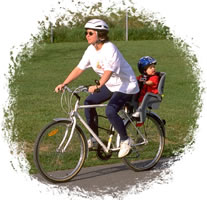
The first is a rear fitting seat, suitable for a child from about 6 months. It has a harness and a high back to support the child, so once the baby can sit up by itself it will be fairly comfortable in here.
My children used to fall asleep in the seat on the back of the bike sometimes. That's a bit awkward, because they tend to loll out sideways. I used to cycle with one hand behind me trying to hold baby in place. Not ideal, but no one ever came to any harm....

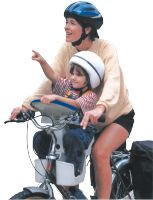
Then you can also add a front fitting seat. These have become more elaborate than they used to be and sometimes include a windscreen. When I had one twenty years ago it was a tiny black saddle with two metal supports, which slotted into a bracket fitted on the cross bar, or the upper of the two angled bars on a women's frame. Then there was a little bracket the provided a foot rest for the child, fitted on the lower bar.

I don't at all like the look of the plastic monstrosity in this picture.


Here is something more like the one I knew (though now they seem to come with a strap to strap the child to the seat: now that was never necessary in days gone by and surely still isn't).

I see there is a weight limit given for these seats. Well I went on carrying our children on them for many years. I had one on the back and one on the front. I went on carrying both children like this until one fateful day when I stopped at a junction to turn right out of Charles Street onto the Iffley Road, and the whole bicycle started to tip over because it was so top heavy. As soon as the structure had started to tilt it was too heavy for me to hold it up, so all I could do was lower it gently to the ground and take the children off. So then we had to walk home and that was the end of cycling with two children one on the front and one on the back.
I don't remember exactly how old they were. Perhaps 5 and 3. Quite a lot beyond the weight limit they recommend now, for sure.

One might also want helmets for the children. Ours were pink expanded polystyrene, and looked like a blob of ice cream. Now that doesn't sound very green does it?

Saturday, 3 March 2007

Cycling with babies and toddlers in tow


Further to my last post, about what you do with baby when you've left your bike and trailer (or bike with child seat) at a cycle park. Good news for parents in Cambridge is the Park Street Cycle Park pushchair scheme, where you can leave your bike for free and borrow a pushchair instead, to go round town.

I have a sort of feeling my children would have refused to get into a strange pushchair. But perhaps if one had been doing it from their babyhood, it would be perfectly routine and no reluctance would be encountered.

More details here and here.

Wednesday, 28 February 2007

Things useful for the task of bringing up children without a car


Besides a pram, we used to find a baby sling useful.

Before the baby can sit up there's no way of carrying it on a bicycle, but you can strap it to your body and ride a bicycle with the baby held firmly to your front. The sling needs to be one that holds the baby's wobbly head in position, and won't drop baby out as you whizz round corners.

I think nowadays people sometimes use one of those trailers that goes behind a bicycle and maybe you can put the baby to lie down in it, or put a car-seat type baby carrier in it.

I think it's debatable whether that's safer than a baby sling. I'm not sure I'd terribly want to cycle on the road with baby in a trailer down there behind, where the cars can't see.

The flag at the back rather suggests that the parent is not entirely confident that the cars won't just drive over it.

Tuesday, 27 February 2007

Chocolate

Results of anti-soya chocolate investigations shows the following ranking.

First prize to Traidcraft Organic Swiss Made Chocolate. The Cappuccino variety is heavenly, despite containing some vegetable oils. Other varieties sampled so far are also delicious: the milk chocolate version has nothing but wholesome ingredients.

These chocolate bars contain no emulsifier at all.

Runners up:
Plamil Organics, non-dairy and gluten free. Contains sunflower lecithin.
Peter Rabbit Organics. Seems to be designed for children, but is sadly dairy free and made with fructose not sucrose. Contains sunflower lecithin.

Flavour not wonderful in either case, doubtless due to the lack of the yummy bits like sugar and milk.

Also ran:
Tesco value chocolate, contains lecithin from Rapeseed. The flavour is fine, but I don't really approve of rape plantations, or of Tesco.

Saturday, 24 February 2007

Sad news on the Urban Farm Shop

I tried to go to the Urban Farm Shop to buy cooking apples today and found that it has shut down. Alas.

Reflections on why it was not a success: one would be its opening hours. It opened too late in the morning. For instance, on a Saturday morning, you couldn't go there first, to buy whatever was obtainable there, and then finish your shopping at the market or the supermarket. But it didn't make sense to do it the other way round, because the range available at the Farm Shop was more limited, and you didn't know what to hope for there.

Also, unlike the Green Grocers, it was not in close proximity to a supermarket or other staple shops, so you couldn't go there in the knowledge that everything you needed could be bought in the vicinity.

Also I think that because of the late opening hour it must have missed out on the mothers taking their children to school, who should have been able to go to school with little Billy, carrying his book folder and lunch box, leave him there and go back empty handed, stopping on the way to buy the vegetables and meat for the evening meal. You don't want to do that shopping when you fetch little Billy from School in the afternoon, because then you have an arm full of his gym kit, lunch box, the paintings he has to take home for the kitchen wall and the invitation thrust into your hand by Emily's mother outside the school gates. Also you need to hold Billy's hand. So doing the shopping then is much less satisfactory than the morning slot after you've dropped Billy at School. So if you open your shop at 10 a.m. you've missed the key moment, if your shop is on the prime route to the primary school.

Friday, 16 February 2007

Things useful for the task of bringing up children without a car

Besides the pram and the toddler seat, by the time the baby is about five months old you need a back rest for the pram (couldn't find a picture of one of these) and a baby harness.

The back rest for the pram is a kind of board with three pieces, which fold round and clip together to make a triangle. This goes in behind the baby when the baby is sitting up (but when the baby needs to sleep you take it out and flatten it and put it in the tray under the pram, or at the foot or whatever). My feeling is that there's something important in developmental terms about this hard back rest, because the baby sits up on a firm base and against a firm support and learns to exercise the lower back muscles to keep balance. This must be expecially good practice if the pram is in motion. Someone ought to do a study to see if children who ride in a real pram between six months and a year learn to walk earlier than those who slouch in a stroller.

I think maybe some prams have a back rest built in, which folds up or down.

And I believe the really old prams with the cavernous coach built body (like the one I myself occupied on my earliest outings) had a removable board in the middle of the base, so that when you removed the matterss and removed the loose board, the pram became two child seats facing each other, with space in the centre for the child's legs to drop down into the body of the pram.

The harness, of course, is for safety, once the child is capable of getting about in various ways by itself. You need one for the baby in the pram and one for the toddler on the toddler seat.

This picture, by the way, is not a picture of me but just a random picture I found on the web.


The toddler seat is also important for child development, not for physical co-ordination but for IQ. You have a conversation with the toddler as you push the pram.
(How very different from the lack of contact with a child in a forward facing pushchair!)

Half term at Tescos

Foolishly I went to Tescos this afternoon (Shock Horror!!).

Lots of families had evidently decided that since it was the last day of half term, and quite a nice day, one should have an outing with the children. Tescos on the Newmarket Road was a popular destination.

The crowds were unbelievable. The children were dawdling round the aisles and peering into freezer boxes. Most of the adult world seems also to have decided to take their lunch break there.

I was not quite sure what the attraction was. I suppose it is maybe a bit like the zoo?

Tuesday, 13 February 2007

Things useful for the task of bringing up children without a car

First, a pram.

It should have large wheels, so as to be comfortable to push for long distances and not bumpy on rough pavements or difficult at kerbs. It should have decent springs. It should have a sizable basket below for carrying large quantities of shopping and other clobber.

A pram like this will also take a child seat for the toddler, so that two children can be transported, and all that shopping too.

Twenty years ago it was possible to take a pram like this in the luggage van of a proper loco-hauled train. I remember taking our pram on the train from Cambridge to London, on a visit to the grandparents, though I have a rather dim memory of how we got from Liverpool Street (or was it King's Cross?) to Dulwich.

I suppose it may still be possible. Is it permissible to put a pram in the cycle storage area of a train? I'm not sure.

Monday, 12 February 2007

The smell of baby

Another thing that was mentioned on Radio Norfolk was the wonderful smell that a baby has— natural baby smell, so to speak.

Do you suppose we are naturally wired up to respond well to the smell of a baby? Or is it imprinting from our early years? Or is that the same thing?

And does nature give baby a special smell so that that happens? And if so, doesn't that also fit with the more general idea that, on the whole, it is best not to do too much to mask the natural smells that enable us to find our children and our mates and so on.

This (by the way) is connected to thoughts sparked off by a theory my mother has about matters to do with bathing, aftershave and the divorce rate. I think dotty theories probably run in the family.

Friday, 9 February 2007

Soya

I haven't yet explained in detail what my negative views on soya are based on. But a Guardian article from July 25th 2006 gives some sense of the nightmare. See also Annie's theories (you have to read to the end of that post to discover the bit about soya).

But now here's another thought: perhaps the soya cloud has a silver lining?

I've just noticed, on re-reading the Guardian article, that it reports that 30-40% of babies in the USA are raised on soya formula. I take it this means 30-40% of babies, not 30-40% of bottle-fed babies (though I guess the few lucky ones fed at the breast may also have their milk heavily contaminated with soya isoflavones). So, assuming the boy and girl babies are both fed on it, this should mean that approaching 40% of US males will be infertile when they grow up. So providing we can ensure monogamous partnerships, and don't allow the girls to go round until they find a fertile male, this should mean that only just over half the population can have any children next generation round. If they continue to choose soya-based milk feeds or even increase their use, the next generation will be even smaller and only half of that generation will be fertile too. So the population will decline until the US is no longer a threat to world peace and stability, because the few real men there are will have to spend all their time trying to beget children, to stave off extinction.

Good God!

Saturday, 3 February 2007

Bringing up children without a car

Two conversations yesterday evening prompt me to post on this theme.

A while back, cycling to work up Recreation Road in Norwich, I encountered a kind of mayhem even more extreme than the usual mayhem caused by people bringing their children to school at Heigham Park First School. Recreation Road is a steep hill, bottom gear variety. On this particular occasion I was struggling up this hill on my bicycle, but was brought to a halt due to the car in front of me having to stop. That was because a car coming down the hill had pulled up to stop and unload children where there were already parked cars on both sides, entrances to drive ways and other complications, in such a way as to prevent anyone from moving up or down the hill.

Stopping a cyclist on a steep hill is not popular. They say that whenever a cyclist is forced to stop and start off again it takes as much additional energy as if the journey were 100 metres longer, but that's presumably if you have to restart on the flat; I suspect that restarting on an up hill slope is quite a lot more.

In this case it wasn't just a matter of starting again. There wasn't actually room for me to continue my journey on the road. In fact I had to get off, walk my bike up the pavement, and get on again beyond the obstruction.

As I went past the mother unloading her child from the car, I asked her, in a rhetorical kind of way, why she didn't bring her children to school on foot. It's always struck me (on the times when I make the mistake of riding past that school at that time of the day) that the ones being unloaded from cars look fat and unhappy, while the ones being walked to school are chatty and lively with a lovely hubbub of conversation with their accompanying adult.

The mother with the badly parked car didn't offer me a reason for why she didn't bring her children on foot. She just said "you've obviously never had children!" as though it was obvious that if you had children you had to be late, in a hurry, shove them in a car, drive to school, yank them out of the car, drag them in to the school door and rush back to move the car, because it's causing an obstruction. No time for goodbyes. No time for conversation. No time to talk to the other parents. Just dump them and run. This is what bringing up children is all about.

Well, perhaps it was a bad day. But if you don't have a car at all, a bad day never looks like that. It may look like something else, but it never looks like that.

"Actually," I said, "I had two children, and we never had a car." By this time I was on my bike and gone. "Never once," I thought, "did my children go to school by car." In fact, of course, they never went to ballet by car, they never went to music lesson by car, they never went to orchestra by car.

Was anyone the worse off for that? Well, our life was not the life of a taxi driver, which seems to be what the life of many parents is these days. And their life was, as far as one can make out, certainly not worse for it. Perhaps, dare I say it, better? Some thoughts on why in due course.

Tuesday, 23 January 2007

The best way to get to Oxford

What's the best way to drive from Cambridge to Oxford?

The simple answer is, don't even try. Just take the train.

But a Sunday morning between 7.30 and 9.30 is probably the best time to sample the route by car, and it is quite pleasant then. Probably preferable to the trains, since one should, in general, never try to go anywhere by train on a sunday morning.

It crossed my mind, as we drove across by way of Bedford and Woburn and Aylesbury and so on, that the roads at that time of day were quite empty, and that if everyone in the country were to do what we do and hire a car about three times a year, that's how the roads would be at the busiest times.

And wouldn't we all be a lot happier then?

And then it struck me, as we looked for a parking space in the narrow streets of East Oxford, that if we all lived like that, then only one house in 100 would have a car on any one day of the year (or maybe two in every 100 if they hired for two days each, three times a year), and that car would probably not be parked in front of their house, because they'd be using it. So there would be no difficulty in parking, because the streets would be entirely empty of parked cars.

They'd be full of children playing of course, as they used to be. But that would be a delight, not a problem.

It's odd, it seems to me, that such a simple way to happiness should be so far beyond our grasp.