Notes from Catherine Rowett, former Green Party MEP for East of England and deputy coordinator of the Eastern Region Green Party*(UK). Biographical reflections on life as an MEP. Longer reflections and discussions on issues relating to policy, the good life, justice, equality, anti-austerity economics and the future of the planet. This is also a forum for exchanging ideas on how to tread lightly on the planet and avoid supporting exploitation and corrupt practices. Here we go...

Monday, 30 April 2007

Hooray the cows are here!


For the first time since before the Foot and Mouth year, cattle on the common behind our house (not just on Midsummer Common but on our bit)!

This is good news not just because they are beautiful, and make nice noises, but because it means the council will not have to mow with a machine (and the nettles and brambles will be better controlled than with one mowing per year which is what we have been getting).
They were extremely frisky when they first appeared and galloped back and forth trying to discover what was what (somewhat to the amusement and concern of the students in Barnwell Hostel, into whose windows the cows—well, rather steers—were peering). But now they seem to have settled down happily in a shady patch of cow parsley....

Friday, 27 April 2007

Things calculated to annoy a cyclist


Cycle racks positioned in such a way that you can't access the further ones when the nearer ones are filled up.

This has the effect that you can't use the further ones, even if you get there first, because you won't be able to get in in order to get out later.

Example, new racks by the front lawn at UEA.

My guilty secrets

This week I bought kumquats from Israel. They were reduced for quick sale, but still it remains true that they were from Israel.

Tuesday, 24 April 2007

Things useful for bringing up children without a car

Last time we got as far as carrying a small baby in a sling or in a trailer. Next we need a baby seat for the bicycle.

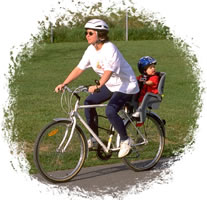
The first is a rear fitting seat, suitable for a child from about 6 months. It has a harness and a high back to support the child, so once the baby can sit up by itself it will be fairly comfortable in here.
My children used to fall asleep in the seat on the back of the bike sometimes. That's a bit awkward, because they tend to loll out sideways. I used to cycle with one hand behind me trying to hold baby in place. Not ideal, but no one ever came to any harm....

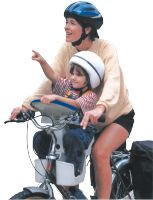
Then you can also add a front fitting seat. These have become more elaborate than they used to be and sometimes include a windscreen. When I had one twenty years ago it was a tiny black saddle with two metal supports, which slotted into a bracket fitted on the cross bar, or the upper of the two angled bars on a women's frame. Then there was a little bracket the provided a foot rest for the child, fitted on the lower bar.

I don't at all like the look of the plastic monstrosity in this picture.


Here is something more like the one I knew (though now they seem to come with a strap to strap the child to the seat: now that was never necessary in days gone by and surely still isn't).

I see there is a weight limit given for these seats. Well I went on carrying our children on them for many years. I had one on the back and one on the front. I went on carrying both children like this until one fateful day when I stopped at a junction to turn right out of Charles Street onto the Iffley Road, and the whole bicycle started to tip over because it was so top heavy. As soon as the structure had started to tilt it was too heavy for me to hold it up, so all I could do was lower it gently to the ground and take the children off. So then we had to walk home and that was the end of cycling with two children one on the front and one on the back.
I don't remember exactly how old they were. Perhaps 5 and 3. Quite a lot beyond the weight limit they recommend now, for sure.

One might also want helmets for the children. Ours were pink expanded polystyrene, and looked like a blob of ice cream. Now that doesn't sound very green does it?

Sunday, 22 April 2007

Asparagus

Yesterday I discovered that you're supposed to eat your first English asparagus on St George's day. We had ours yesterday, but that probably reflects the reality of global warming, as I overheard the market stall man saying to another customer.

Saturday, 21 April 2007

Recent railway adventures

Here is how I went to Switzerland for a conference last weekend.

  1. First I rode my bicycle to Cambridge Station.
  2. Then I took a First Capital Connect train from Cambridge to King's Cross.
  3. Then I took two underground trains to get from Kings Cross to Waterloo.
  1. Then I took the Eurostar to Paris Gare du Nord.
  2. Then I walked from Gare du Nord to Gare de l'Est. Gare de l'Est is currently under reconstruction, but there was a waiting room.
  3. Then I boarded the night train heading for Zurich and Chur. The coach I was booked on didn't exist but they had reassigned me to an alternative one. It was, as requested, an all women couchette compartment.
  4. Next morning at 0450 I got off the train in Basle and crossed the border into Switzerland.
  5. At 5 a.m. the coffee shops opened so I had some breakfast.
  6. Then I caught a train to Luzern.
  7. At Luzern I was met by a representative of mine hosts and driven by road to Vitznau. This was a disappointment as I had hoped to complete the journey by way of the paddle steamer across the lake (but I think my hosts didn't appreciate that one might prefer to use the public transport method. Certainly I would have needed to wait perhaps an hour or two for the first boat I suspect).
On the way back I did the same thing in reverse. Total number of legs to the journey there and back, eighteen. Total journey time about 15 hours each way. But because most of it was at night, I actually got two complete extra days at my destination and lost very little usable time.

I suspect that a journey by air would have taken about 7 hours each way and cost about half as much. My original plan had been to cross the channel by sea rather than by Eurostar but by the time I came to book the travel agent claimed (somewhat implausibly, I thought) that there were no trains from Paris to Calais with available seats on the day I wanted to return. Next time I will make an effort to get it right. I don't much like the way the Eurostar tries to pretend it is an airline, creating just the very ambience one is trying to escape.

Eurostar (they tell me) is "ten times less polluting than flying". I suppose that means it emits about 10% as much CO2. They're trying to save further on the per passenger CO2 footprint now: well they could start by letting us wait in a normal building or on the platform instead of a horrible cramped air conditioned "departure lounge" with no windows and no natural light and most of the space taken up with silly airport shops and duty free outlets.

Yuk. Just let us travel in good old railway style: that would appeal much more to those of us who want to break free of the consumer society.

Pantzaria Salata

Here at last is the best beetroot recipe ever. This dish we learnt to love at the British School in Athens.
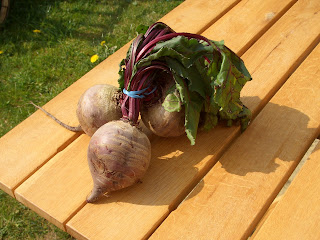
I have saved it till now because it belongs to the season when bunched beetroot are on the market, fresh with their green tops included. This time has now come, thanks to global warming.

There is a tale to the effect that it was to get beetroot with their tops on, for the purpose of this wonderful dish, that the Osborne family moved back to Cambridge. But amazingly, last time I was in Oxford I saw a bunch of beetroot on Oxford market. Wonders will never cease.

Pantzaria salata (or "Beetroots done the Greek way").

Ingredients:
1 bunch of beetroot, small and young with the tops green and fresh
olive oil (lots) and a little vinegar if desired
nutmeg

method:
Cut off the leaves, leaving about an inch of the stem on the beets. The leaves will be treated as chard (much like spinach).

Wash the leaves and the roots. Put the roots in a large pan of cold water and bring to the boil. Boil them until they are tender (about an hour at the most).

Meanwhile, put the clean wet leaves into a pan just big enough to hold them. Don't add any water (the water on the leaves will be sufficient). Wilt them over a low to medium heat with the lid on. After about 15 minutes or so they will be tender and cooked, including the long red stems.

Drain the leaves in a colander, and then using two sharp knives running in opposite directions like scissors, cut through the cooked chard, including the stems, so that it is well cut into small parts, with the pieces of the stem no more than about half an inch long.

When the roots have finished cooking, drain them and rub off the peel (if they are done the peel will come away easily). Cut off the top where the stub of the stalks is and the trailing root at the tail and cut them into slices. Arrange the slices on the centre of a platter. Spread the chopped chard round them.

Drizzle as much Greek virgin olive oil as you dare over both the roots and tops until they shine with a lovely gloss. If you like, add a very small amount of vinegar (or lemon juice) and a grating of nutmeg over the top.

Serve lukewarm or cold.